 Home |
The Boat |
First Mate
|
Admiral |
Guestbook
Home |
The Boat |
First Mate
|
Admiral |
Guestbook
Date: 16 September 2013. More Trolling Motors.
© janice142
A reader suggested I expand upon the whole trolling motor as an alternative to noisy gasoline outboards immediately, and he had the temerity to hint that men do not want to wait. Who would have thought a man impatient?! So this article focuses on these $100 miracles and details on battery life, charging, etc.
I am a big proponent of easy and inexpensive. That my choice happens to be environmentally sound is all the better. Because my intention is to live decades aboard my home, long-term comfort and convenience even as I age have become if not paramount, quite close to the top of my awareness scale. And for ease of use an electric (12 volt) trolling motor meets my requirements.
|
Gasoline powered outboards are heavy and expensive. See the chart: |
|||
| Horsepower | Weight of Motor | Price* | |
|
For me due to poor upper body strength, starting a pull-start outboard is not possible. Plus, these units are noisy, smelly and cost too much. |
2.5 Nissan | 41 pounds | $899.00 |
| 4hp Nissan | 58 pounds | 1,160.00 | |
| 8hp Nissan | 81 pounds | 1,760.00 | |
| 9.8hp Nissan | 81 pounds | 1,960.00 | |
| 15hp Nissan | 114 pounds | 2,430.00 | |
| 20hp Nissan | 114 pounds | 2,680.00 | |
|
*Prices as of today 16 September 2013 at www.onlineoutboards.com |
|||
I do a ride in the gasoline
powered go fast marshmallows though.
It is nice to be able to get to shore rapidly. My trolling motor is
slow.

Of course if your motor weighs a lot you are going to need some accessories such as a harness to help when hoisting said motor, a secure place onboard to stow the motor when underway, a lock to help keep folks honest when there is an expensive outboard motor sitting around unwatched, etc. Plus it is a good idea to know how to clean out your carburetor, because ethanol in gasoline is the bane of cruisers' outboards. Have I mentioned buying/carrying gasoline fuel for the motor? Oh, and you need the money to pay for the motor in the first place. But other than that...!
|
You could opt for a
Minn Kota Endura C2 30 Freshwater Transom Mounted Trolling Motor (30" Shaft) |
|


I am sure you are wondering about charging. Here is part one of my system: The battery. I chose a small lawn mower battery, selecting the one with the highest CCA (Cold Cranking Amps) of the two $25-$30 batteries available in Wal-Mart's battery department. The higher capacity has a rating of 40 amp hours. These batteries are small so that I can easily handle them and the price works for me.
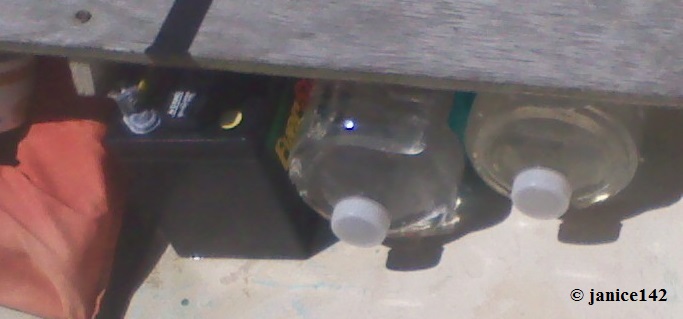
Initially I bought two, figuring to have one on Seaweed re-charging and swap out as necessary with the one in Algae. Then I loaned one to a fellow who left with it, accidentally of course. And yes, he will return same along with a dinner at a restaurant where there are waitresses to both take order and deliver same. This is not going to be a burger joint. And yes, I will bet shrimp will be involved, or perhaps surf and turf... (smile)
So my initial plan needed some alteration. What I made was
this:

This is the cord off an old battery charger that bit the
dust, attached to a male cigarette lighter.
Each night I would bring the battery inside and plug it in to recharge. Although I say "recharge" what I really mean is that it will come up to the level of my battery bank, so equalize would probably be the better term. As I keep my batteries well charged with wind and solar, this works for me.
However I am woman and the routine to get the battery out of Algae each night rapidly got old. For a time I would feed the cord out the pilothouse door and just attach to the dink while she was rafted next to me. That was okay but the noise of the dink bumping Seaweed was bothersome.
I can feel the waves of sympathy already;
it's a rough life out here... somehow we manage.
Skipper rests after a vigorous day of snoozing:

The next plan was to take some spare 14 gauge wire I had on hand (two 25' spools) and run it to the transom. Between the outer hull and the inner liner is an area and I envisioned a set-up where charging would take place aft, where Algae "lives" at night. This is what I came up with:

Please note that everywhere there are two wires on the boat, the neutral/ground is on the left and the Positive (red) is on the right. Alphabetically N is before P so I've copied it throughout. If I have to attach something in the dark I know that as long as Red is on the right I am good. It's simple!
So, the wires (ring terminal ends with heat shrink, plus electrical tape) are permanently bolted to the block and when I want/need to charge Algae I'm all set. That hole you see to the right? It has been there since the boat was built. For now I push thru the ends I attach to Algae's battery (see next picture) so it is more tidy. At some point I shall find a light to go out there. Power is available, so Skipper will soon have a lit swim platform at night.

Take a look at the ring terminal ends. It's handy to have some red paint around for when those wires are barely distinguishable (one has writing and one does not) so you can add a bit of paint to show easily the positive side. I use the small bottles of acrylic paint found in art departments. At Walmart the 2 ounce plastic bottles are about a dollar. It's not fancy, it works, hasn't hardened after years, and best of all is inexpensive insurance against dumb mistakes.
The clamps attach to the ends of the bolts as shown in the picture previous and the ring terminals slip thru that hole in the transom hull and attach to the battery in the dinghy. Once attached I close the Beckson Deck Plate and voila: it's neat and tidy again. I like my stuff put away.
Now I suppose in light of that you might wonder about the fishing net that's hanging right there? Of course I always have my Skipper in sight when she's outside of the boat and on the swim platform. That's her "outside" if you get my drift. She has backed up a little too far or leaned over to watch a fish, and on the rare occasion has felt the need to Baptize herself. Thus I have an easy way to get her out using the net. Then it is into the sink for a fresh water rinse and a gentle Oster Oatmeal dog shampoo. This brand smells great too.

Unfortunately, my Skipper is not her most attractive when
wet:

I charge or more accurately equalize the battery in the dinghy with my battery bank aboard the boat. Next we need to think about batteries themselves. I have gone with an inexpensive $30 lawn mower battery from Wal-mart (the better of the two they offer) and according to a friend its capacity is 40 amp hours. That means I can safely, regularly, use up to 20 amps though I try to keep it down to 10 amps before recharging.
Now if my budget was not quite so tight I MIGHT opt for one of the Walmart automotive batteries, as long as I had a way to charge the battery without lifting it out of the dinghy. Therein lies one reason to pick a smaller lawn mower batt. It is light weight. Also, the smaller battery slides right under the seat at the transom so it is easy to hide. A full sized Group 27 or larger battery might be a temptation to someone with sticky fingers.
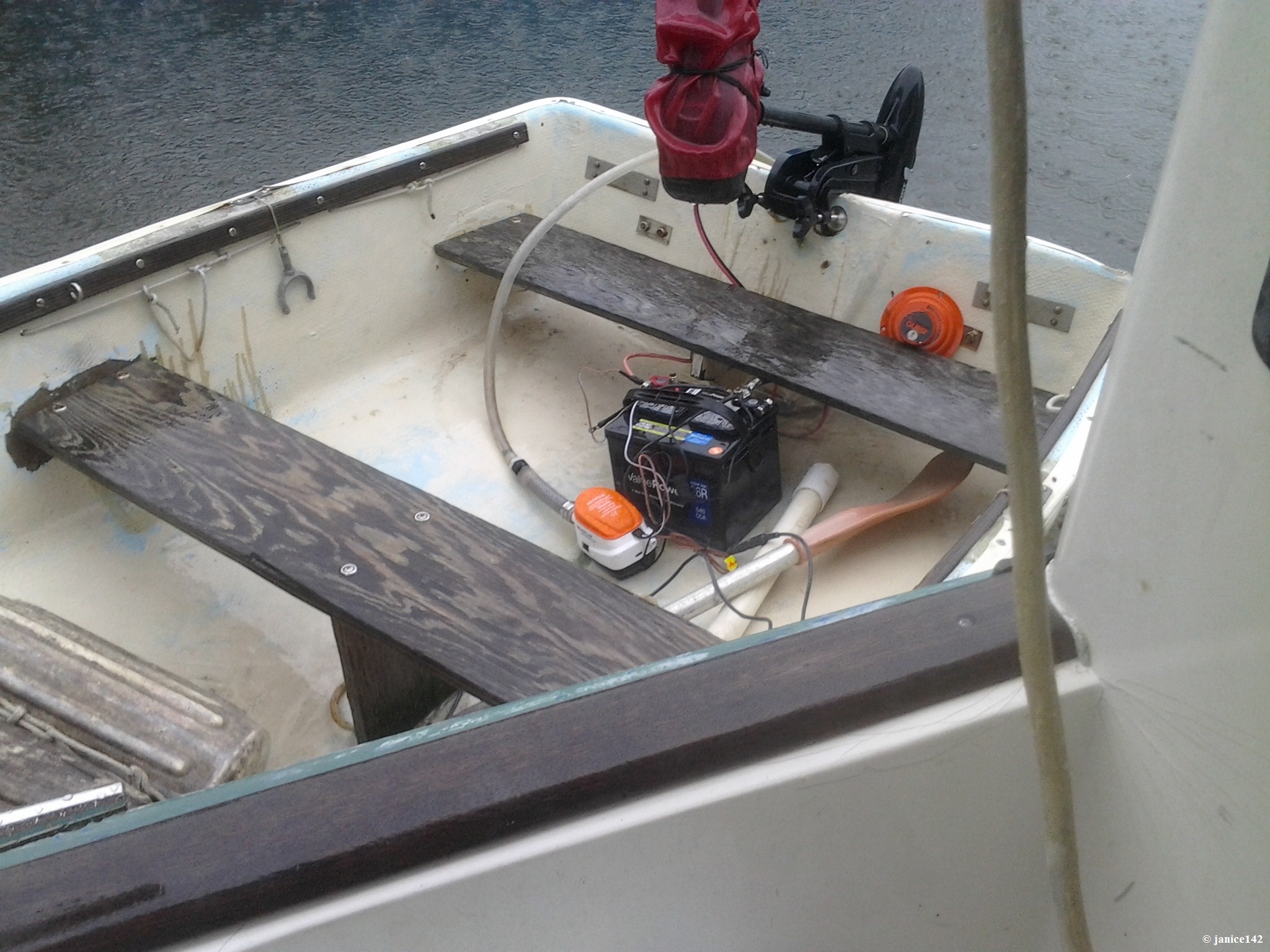
I hooked up a
SeaFlo 750gph Automatic Bilge Pump
so I do not have to manually pump out the dinghy when it rains.
Aside: I've been using the Walmart automotive batteries for three years aboard Seaweed as the house bank without issue. I seldom take them below 12.3 and they are working fine. Eventually I'd like to upgrade to the marine batteries Walmart sells (I do have one marine Group 29) but that's a someday thing....
Budget cruising means at times making do without
what is
considered the best, but I'm out
here living the life so it's all good.

|
Let us pause for a smidgen: When referring to amp hours
that is a designation for how much power is available. Though the capacity
of my lawn mower battery is 40 amp hours experts say I should
use only half (or less) of that. Thus I have 20 amps of usable
power. |
What I wanted to know was how much amperage the Minn Kota 30 Trolling Motor used at various speeds, so I wrote the company. And yes, I received a response back within 24 hours. That is impressive. This is what I was quoted:While we do not have exact amp draws at speeds 1-4, but I can give you some estimates. Speed 1 will draw about 6 amps, 2 will be about 10, 3 about 14 and 4 about 18. It takes a big jump from there; when it is on speed 5, the motor will draw up to 30 amps. In reverse, speed 3 is about equal to 5 in forward. I really do not have any information about speeds 1 and 2 in reverse, but you can make some estimates based on the forward speed.
As you can see should you run your 30 pound thrust (smallest/least costly version) trolling motor on #1 it is only going to use 6 amps per hour. I do not know anyone who runs a boat full-tilt for more than a half hour to reach shore so even if you go up to Speed 4, you are still within the 50% factor of a lawn mower battery by the time you return home.
Puttering along a shoreline is relaxing in a dinghy with a trolling motor:

Of course a larger battery means your run time is extended. You might want to know I used my motor in a 10' marshmallow (aka inflatable rubber dinghy) with a group 31 battery without a problem. On three she would move right along even against the wind and current. Four was almost "too fast" when the waves were kicking.
Me? I'm a hard rowboat advocate -- but that's another article some day.
My Algae is a 1972 fiberglass dinghy. Though a bit battered
she is almost indestructible.

The Suzuki is attached to a go-fast boat near me.
One other thing you should be aware of. Pounds of thrust equal approximately 15 pounds per horsepower, so the Minn Kota 30 is about equal to a 2hp outboard. It weighs according to Amazon 16 pounds. The Nissan 2.5hp above cost $899 (see table at start of article) and weighs 41 pounds without gasoline sloshing in the engine. It would take a long time and a lot of Minn-Kota's to equal that amount of money.
Amazon has tons of reviews and one thing I noted was some folks dinged the motor because the propeller broke a blade. That's a $17 fix. Buy a MinnKota MKP-2 Replacement Prop and do not worry about a thing. It comes with the new hub, screws and such -- so you can do a total replacement using all new parts.
|
|
Look at the motor and you can see there is a small metal keel of sorts ahead of the prop. Soft groundings will not hurt a thing. I ran aground with mine many times and really, what finally took out a blade I believe was a combination of the prop being in the Florida sun baking for three years and that log I did not see. When home I always raised the motor out of the water so it sat in the sun and probably did become brittle, which in my mind is to be expected!
|


Also, my original propeller was three blade and the two blades were less expensive, so I replaced the three with a two. I could tell no difference in speed or handling, plus storing a spare two blade was easier as it's less bulky.
Now when you visit Amazon I know if you have a smidgen of testosterone you are probably going to think "well if a 30 is good, then 40 is better and wow, they have even larger ones over here" but I would encourage you to not do it without thinking carefully! These motors are actually designed for bass boats and the length of the shaft on the bigger units is quite long. The 30 has a 30" shaft but I've seen them with 42" and goodness knows that is more than my Seaweed draws. Power draws will be significantly higher with the large motors too.
You can lock them so the bullet part at the bottom does not descend too far but a better option should you select the bigger units would be to consider cutting off the shaft and shortening it. Be aware there are four wires running down to the lower unit. The red and black (forward) is a larger gauge while the blue and yellow are smaller for reverse. Do not cut those wires!

You need to know: If money were no object I would definitely choose one of the salt water trolling motors for a number of reasons: The salt water units usually have a stainless bullet versus the powder-coated steel of mine. The seals are different (better) in the salty versions but all are designed to keep out water. Most (but not necessarily all) of the hardware is stainless inside too. That said, in the salt water versions the electric wire is tinned (silvery color) over copper -- and that is preferable. Still, the wire from the head to the battery is just your standard battery cable so it's not fancy in either incarnation.
|
For me all those things noted above make a salt water
version the best choice however when I factored the budget I live within, I opted for
a $100 fresh water model. If money were no object... well yes, I would go
ahead with a white salt water version such as
MinnKota RipTide
50
|


About that solar panel in Algae... it's great! This one is similar to mine, if you are curious that is: Solar Panel Battery Charger Kit. It is little and since I hooked it up I have not had to plug in the dinghy for charging.
I usually go ashore (1/2 mile round trip) every other day and so far, the battery is remaining over 12.6 -- fully charged. A solar panel is a good addition to consider. Mine is flexible and I tied it on the seat at the bow of the dinghy so it is out of the way and gets full sun for the most part. I do cover it when running the dinghy but the rest of the time the solar panel is fully exposed.

Of course as the dinghy has a battery the next thing on my agenda is to install a bilge pump, and maybe lights... I've already got a gimbaled cup holder, and what with my parasol... well, it's a rough life but somehow I manage.
And last but not least, these quiet gems are clean. I can lay the motor down in the bilge or (the more usual) attach it to the transom on the inside by my stop anchor. It is out of the way and even for me, an easy on and off chore when I come into a new anchorage. Never tow your dinghy with the motor on, but you knew that already I am sure.
I do keep a cover over the top of the trolling motor to
protect it from the sunlight.
Yes, of course there are times when my head is turned by a 9.9 as it whizzes by on the way to shore... yet still and all, I am pleased I've found an alternative that works well and is within my budget. Take a look and see if a Minn-Kota trolling motorwill suit you and your cruising style.

Algae is secured to Seaweed at both an external U-bolt near the waterline
and another fastening spot inside the dink.
Living aboard should not be about endurance, but rather, about living life to the fullest, enjoying each new anchorage and getting in touch with nature as you cannot possibly see it in an urban area. A trolling motor will allow you to with ease become a silent part of the natural world. Wildlife is not frightened away by a noisy smelly motor. One of these days I am going to buy myself a pocket digital camera to show you how close I can get to the critters ... maybe for my birthday on 27 October!
What powers your tender?
Is there other information regarding trolling motors I missed? Please realize I am not an expert -- merely a boater who uses stuff and expects it to meet my needs/expectations.
|
Regarding the Comments Section, found at the end of every article:
|
COMMENTS:
© 2013, 2023
Trolling Motor Woes ~
Previous Post ...  ... Next Post ~
Screening Seaweed
... Next Post ~
Screening Seaweed
First Mate's Gallery now open ~ Crew photos welcome via Email.
The Archive holds a running list with synopsis of published articles, and links to same.
A favorite aphorism: No matter how wealthy you become, you'll never have enough money to buy back the weekends lost working. Dick Bradley. Motor Boating & Sailing Magazine.
Every gift helps.
The Cruising Kitty is what boaters refer to as spending money. There's never enough aboard Seaweed!
I am also an Amazon Affiliate.

My Buddy, and his girlfriend...