 Home |
The Boat |
First Mate
|
Admiral |
Guestbook
Home |
The Boat |
First Mate
|
Admiral |
Guestbook
Date: 29 September 2015. Canning 10 Pounds of Chicken.
© janice142
Posted late due to life, followed by bandwidth issues. I will be adding to my bandwidth starting in October. As for Life aboard Seaweed, it has been incredibly busy, and productive. More about that in upcoming articles. J.
Of late the grocery stores have been having sales on chicken. At 49 cents per pound in ten pound bags, that is quite a deal. Of course I could never eat that much before it would spoil. Thus, I broke out the crock pot and pressure cooker, canning the chicken leg quarters into meal sized jars. Here is how I did it.

For this project a regular full sized crockpot is a
much better option. Check around and try to borrow one or get one
from a thrift store.
|
Quite
frankly, if you do not have a large boat this crock pot will
be too big to fit easily into a locker. On the other hand,
if you wish to process and can a lot of chicken, this one is
ideal. It is also perfect for my famous taco
soup. |

First, be on the lookout for bargain chicken. The ten pound bags do go on sale every couple months so when you get the opportunity, stock up. I ended up buying six bags over the space of a week, canning one ten pound bag per day.
The initial couple bags frankly were a pain in the posterior. It took experimentation to get it down to a science, and I believe I am there now. The final four bags were a breeze. Today's lesson will cover what I did wrong at the beginning along with the improved version.
|
Canning
meats is not about saving |
| I am past
the half-century mark and goodness knows I do not need any more
fat in my system. The canned meats you buy at the grocery or
dollar store tend to be very high in sodium (aka salt) and
fat. Plus, I enjoy canning my own food stores.
Additionally, I know what is in my jars. More importantly I know what is not in them. For example, there is no salt, no fat, and lots of meat. Nothing but a little broth on top of a jam-packed jar of chicken. Yummy! |
|
Pick up can. Shake it. If it
is real slushy
and you hear water, put it back. There is not much product
and too much gooey imitation gravy in the can. The ones that
do not slosh are okay. Barely.
|

So, you have found bags of chicken. Good start. I bought chicken leg quarters because that was the least expensive I could find. Also, I happen to prefer the dark meat. Chicken breasts work too and are less "trouble" in that there are fewer bones.
This is your canning project, so pick what you want to eat. And know this: if you do not eat dark meat now, you will not suddenly like it when you are at sea. Stick with what you like. All too often beginning boaters go with what the "experts" say is necessary. While chicken is one component of my happiness quotient, I realize not everyone is the same.

I found if I
did not like a food ashore, being afloat did not change a thing.
Only preserve what you enjoy. Otherwise it is just a waste of time and
resources.
For me, I opted for chicken leg quarters. The first step in my new improved canning process is to get the chicken naked. Chicken fat migrates to my aft end and goodness knows I do not need more of that!
|
|
For the men-folk who
do not know chicken, the easiest way to strip naked a chick is
to run your thumb under the skin along the
STRAIGHT FLAT AREA. Then pull
the whole skin down and off the end of the leg.
|
|
This is the finished
product: |
|


Next, into the crock-pot goes the chicken sans (without) skin. I am using a larger crock-pot belonging to a friend. Mine is just three quarts and fits perfectly in my galley sink when underway. When doing a massive amount of chicken like this however, having a larger crock-pot did make the process quicker.
It looks icky when it first starts to cook. Keep the
lid on and do not worry: it will be fine and taste great too.

The observant will notice the broth above is chicken-y. This is one of the later batches. I do not add water except to the first chicken leg quarters I am cooking. The crock-pot creates liquid. To the first batch of chicken, I add one cup or two of water to the crock pot. Turn the crock-pot on high if you are in a hurry or low if you would prefer to let things cook overnight.
Side Note: Save the liquid for later batches. I reuse it. You also can pour it off into a Tupperware container. Stick the broth in the refrigerator. When it cools there will be a layer about 1/4" thick of fat. Remove that and you have got yummy fat-free broth for future batches.
Side Note regarding chicken fat: Some folks actually save chicken fat. It is rich and flavorful. It is used with liver when making pate (that mashed stuff with liver and fat) along with adding flavor to plain white rice. Frankly though I am not a fan.
|
Next, pluck the chicken. With
the first two Batches-from-Hades I plucked the skin and bones
off for each set as needed for canning. The chicken was hot and
my fingers were scorched a bit.
Ugh. |
|

Subsequently, I got smarter. When the chicken is falling off the bones in the crock pot, I remove a few pieces at a time. After letting it cool a bit, pulling out the bones is easy. The gristle and bones are set aside for the fish and crabs.
Side Note: In areas without good tidal flow aka current, it is best to bring food scraps to shore for disposal. Here on the Gulf coast, I tap three times on the hull and over the side it goes. See Fish Training 101 for my chumming method.
I am
currently in St. Pete, on Florida's Gulf coast.

Ten pounds of chicken leg quarters becomes four pounds of chicken
without bones.
To can the chicken, you will next put the plucked chicken into a pan with some of the broth you cooked it in. Get it hot and keep it hot until you process in your pressure cooker.
After the pressure has come up, time for the 1/2 cup jelly jars is 1 hour. I do the half pint jars the same amount of time. Mostly that is because I am processing batches with both size jars in my pressure cooker at the same time.
|
How to use your Pressure Cooker: |
|
I've written a pair of articles providing
specifics on how I can and preserve meat aboard Seaweed. The novice should begin
with: Those who have experience
canning vegetables or jams may start with: |

For me canning is a relaxing way to spend the day or three. I like knowing that the food I eat is good for me. The quality of home canned is better than what I could buy. Plus, the quantity suits my appetite.
A bargain
isn't so if the amount of product spoils before I can consume it.
That is why price is not so critical for me. Often I will purchase smaller quantities at a greater cost per ounce because I know I will use it all. Too, more and larger are not such a good idea when storage space is limited. By canning my own smaller jars of meats I have a ready made dinner with the ease of removing a lid.
I bought
sausage a while back. After cooking I sliced the chicken sausage
(less fat/healthier for me) into wafers and then processed in jars.
Now when I want pizza, or spaghetti or a sausage sub I have just the
correct amount ready to eat. All I have to do is open the lid.

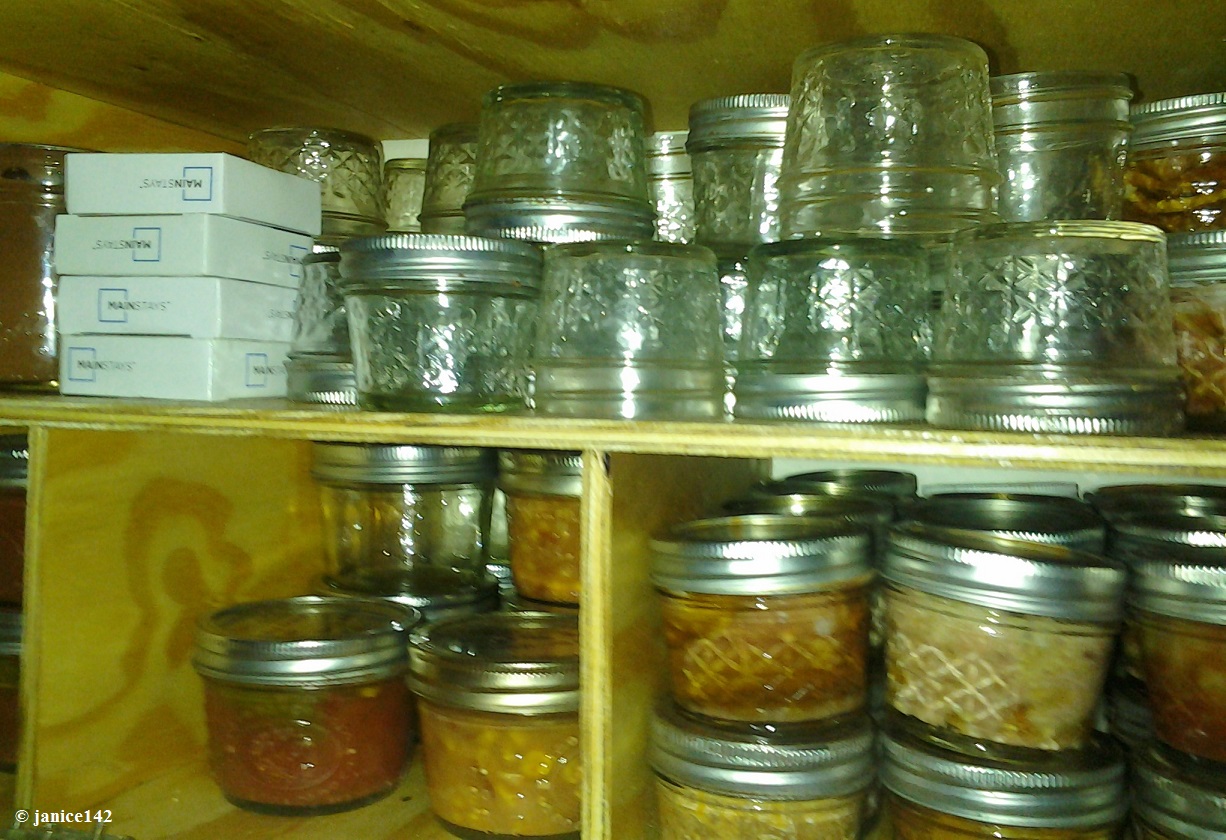
When chicken is 49 cents a pound, its hard to pass up a deal like that. I am only limited by the number of jars I own, and the desire to have a variety. Fortunately for the budget I like chicken.
Next I will do some bratwurst. It is three pounds for $10 at Walmart. A few jars of sausage chips (1/4" thick wafers) will be a nice addition to my larder.
|
Update:
After buying three pounds of bratwurst at Walmart with high
hopes of a bargain sausage for the larder, I tasted them. They are not my
thing. In the meantime, I will add them to eggs for my omelets.
To can them for later would be a waste of time.
For
yourself, I would advise the same: If you do not care |
Are you a canner?
Was canning foods a part of your younger life?
|
Regarding the Comments Section, found at the end of every article:
|
COMMENTS:
© 2015, 2023
Locker Latch Alignment ~
Previous Post ...  ... Next Post
~
Backing Plates
... Next Post
~
Backing Plates
The Archive holds a running list with synopsis of published articles, and links to same.
Every gift helps.
The Cruising Kitty is what boaters refer to as spending money. There's never enough aboard Seaweed!
I am also an Amazon Affiliate.

My Buddy, and his girlfriend...