 Home |
The Boat |
First Mate
|
Admiral |
Guestbook
Home |
The Boat |
First Mate
|
Admiral |
Guestbook
Date: 4 October 2015. Backing Plate Concerns.
© janice142
Yesterday we discussed what a backing plate is. Today I shall tell you how I took a $12 cutting board and turned it into a Good Enough backing plate for a shelf I am building in my galley. All of us know that there are times when we must opt for the higher quality product. Fortunately for my budget, this is not always as necessary as some might think.
It all started because of the gift of a refrigerator. That was made possible because I have more solar panels. Celebrate with me! Because of that additional power, a lot of changes occurred. I am beyond ecstatic to have Plenty of Power. This is something I dreamed of for years...

Each improvement seems to morph into more. It is called Job Creep [←article link] and sometimes it is fun. This time, definitely my life is improving to a grand extent. I will be able to run a refrigerator/freezer all the time and that is a true blessing. Larry and his Eva made that possible.
I am very grateful to both Eva and Larry for the pair of solar panels. Soon, I will be raising a glass of tea (with ice!) while living off the grid. Life does not get much better than that.
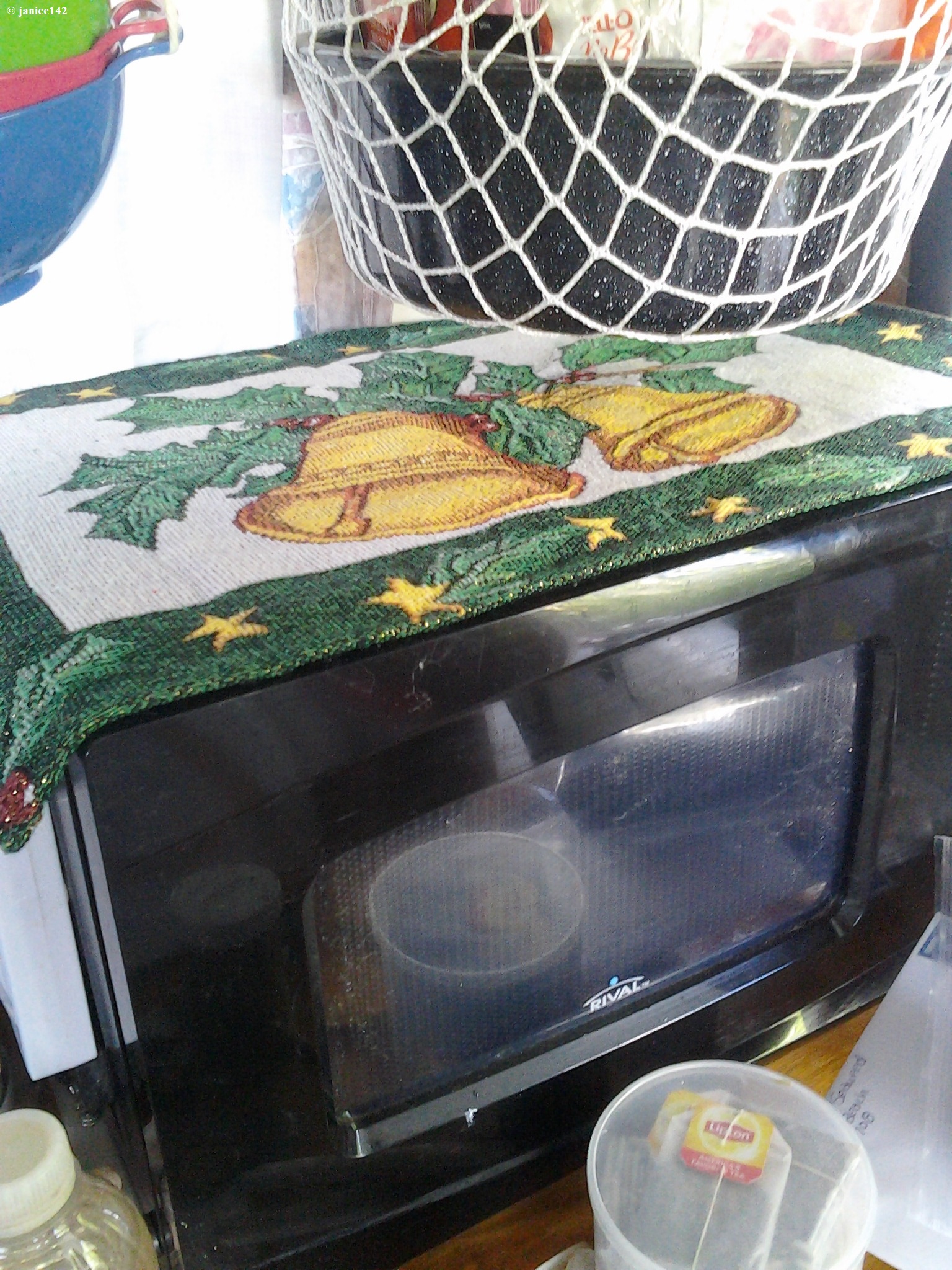
Now that I have the power to supply a refrigerator why not by a microwave too? I found a small one on sale and brought it home. However I did not want to just sit the microwave atop the reefer. Thus the need for a shelf.
|
To make sure the support hinge does not pull through the aft bulkhead, I needed a backing plate. I gave a bit of a Primer on the whys and wherefores in the Backing Plates article yesterday. |
|
|
|
|
Side Note: My friend Stu is
the author of
Dictionary of Nautical Terms by Stuart Warren |

 .
It is available on Kindle and far more thorough than my own
Boat Talk page.
.
It is available on Kindle and far more thorough than my own
Boat Talk page.
After deciding I needed a backing plate, the next problem was in finding something that would work and be within my limited budget. It dawned on me that some cutting boards are a similar material. The plastic will not easily break. I decided to buy and use a 1/4" thick cutting board as the backing plates required for the galley shelf project. The one I bought from Walmart was $12 and measured 15" x 20". As a bonus, I have lots left over for other projects.

Three strips were cut, each 17" long. That is the
length of the stainless hinge.
I determined three backing plates would be sufficient for the task at hand. One is outside in the cockpit. To sandwich the back bulkhead, the second is on the inside between the upper half of the hinge and the bulkhead.
The third
will go under the shelf board and extend an extra inch as
a support
for the wood. The
three backing plates are 17" x 2" wide.
|
Backing Plate Concerns: |
FENDER WASHERS AND NUTS
secure the backing plate
to the aft bulkhead.
It was done that way so the shelf could raise flush with the back bulkhead. If I had the wood on top of the hinge it would not lift properly. The thickness of the shelf would prevent the hinge from folding completely. |

When I went looking for my fender washers I discovered I did not have enough for the project. It is convenient to have a toy store aka marine hardware store so close by. I stopped in at Beach Hardware [http://beach-hardware.com] in Madeira Beach where I met the nicest gal. Robin helped me find all the goodies I needed.
Prices are
reasonable at Beach Hardware too. That is
definitely a bonus for those budget conscious folks out here.
Jim is the owner and his phone number is 727-420-0421.

I came home stoked to finish the project, anticipating zero problems.
Sometimes I can be so naive...
Have you used a cutting board for something other than chopping onions?
What did you do with it?
|
Regarding the Comments Section, found at the end of every article:
|
COMMENTS:
© 2015, 2023
Categories: Boat Talk, Books, Characters, Galley, Gear, Locations, Money, Recommendations, Vignettes
Backing Plates ~ Previous
Post ...  ... Next Post ~
Keeping in Touch with Grandchildren
... Next Post ~
Keeping in Touch with Grandchildren
The Archive holds a running list with synopsis of published articles, and links to same.
Aphorism Alert: Ancora Imparo, Latin. On sketch by Michelangelo meaning "Yet I learn" or "I still learn".
Every gift helps.
The Cruising Kitty is what boaters refer to as spending money. There's never enough aboard Seaweed!
I am also an Amazon Affiliate.

My Buddy, and his girlfriend...